
Turn abandoned patents
into your own filing
into your own filing
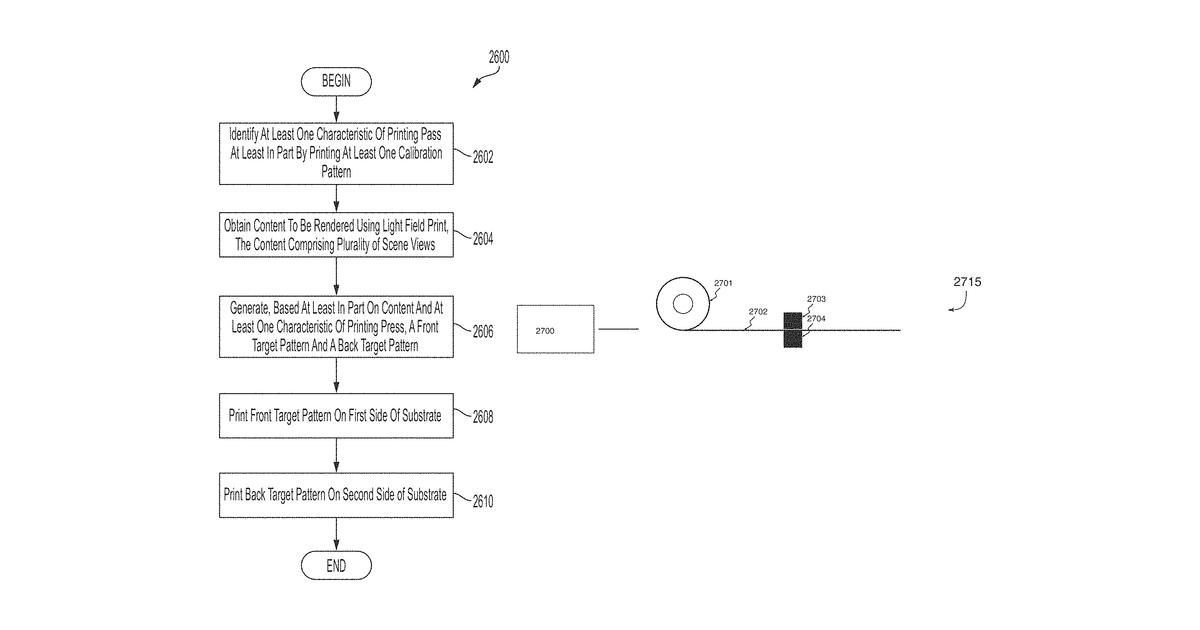
This invention describes a method for creating special 3D-like images, called light field prints, using a standard printing press. It works by first printing calibration patterns to precisely measure the press's specific limitations, such as its alignment accuracy, minimum line width, and resolution. Then, software takes multiple views of a scene and uses that content, along with the measured press characteristics, to generate two precise patterns that are printed on opposite sides of a material to create the final light field print.
Why it matters: Filed before the widespread adoption of advanced computational imaging and AI-driven optimization techniques. The complex pattern generation and distortion compensation described in the claims, which were computationally intensive in 2018, are now significantly more tractable with current software and hardware capabilities.
AI gives you a few directions you could take this. Pick one, and we check whether your version is different enough to patent, then write the filing.
Reinvent this with AI


